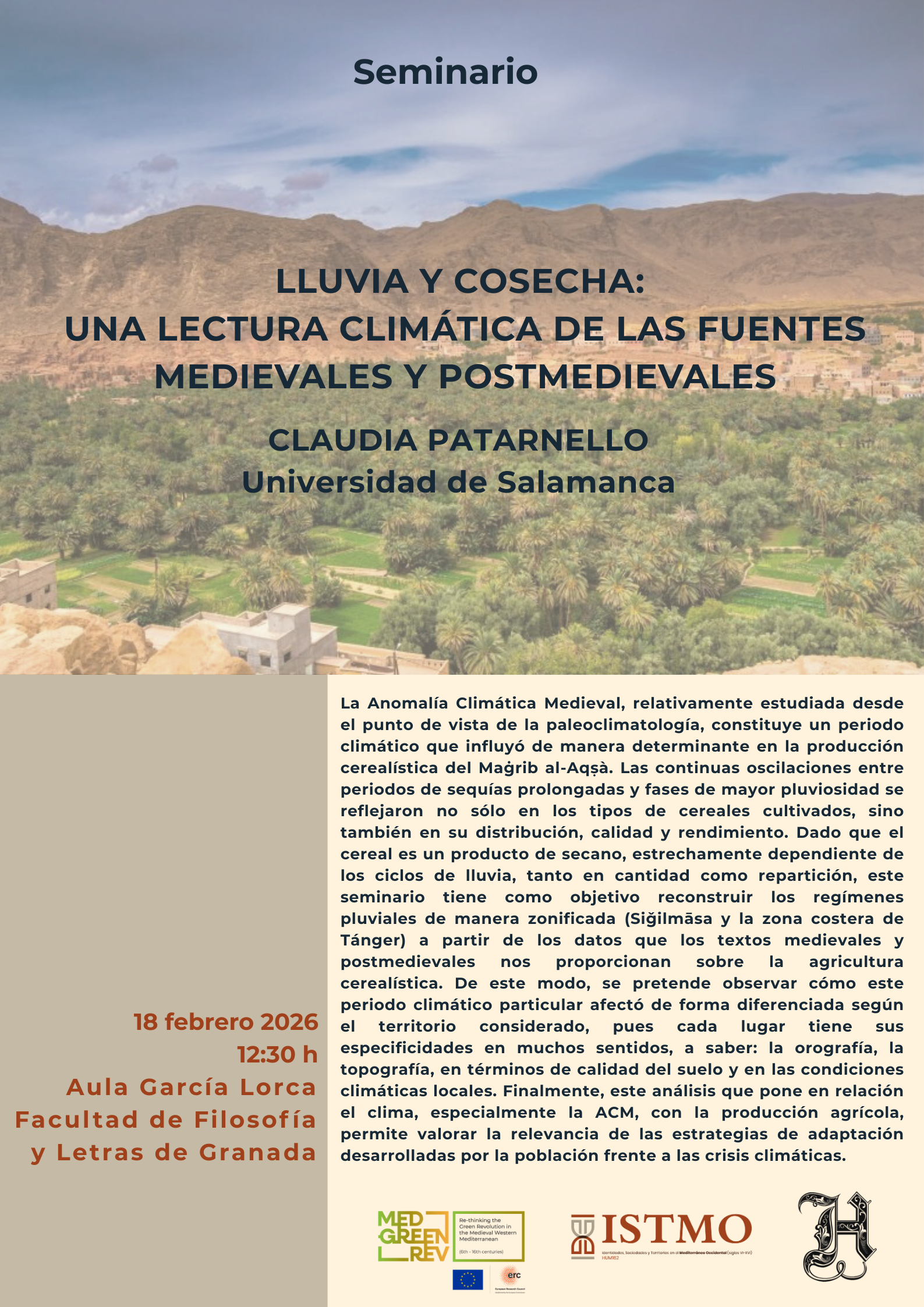
The Medieval Climate Anomaly, relatively well studied from the perspective of paleoclimatology, constitutes a climatic period that had a decisive influence on cereal production in the Maghrib al-Aqṣā. The continuous oscillations between prolonged droughts and phases of increased rainfall were reflected not only in the types of cereals cultivated, but also in their distribution, quality, and yields.
Given that cereals are a rain-fed product, closely dependent on rainfall cycles in terms of both quantity and distribution, this seminar aims to reconstruct rainfall regimes in a zonal manner (Sijilmāsa and the coastal area of Tangier) based on data provided by medieval and post-medieval texts concerning cereal agriculture.
In this way, the intention is to observe how this particular climatic period affected different territories in distinct ways, since each area has its own specific characteristics in many respects, namely: orography, topography, soil quality, and local climatic conditions. Finally, this analysis, which relates climate—especially the Medieval Climate Anomaly—to agricultural production, makes it possible to assess the relevance of the adaptation strategies developed by the population in response to climatic crises.
Seminar by Claudia Patarnello (University of Salamanca) on February 18 at 12:30 p.m. in the García Lorca Lecture Hall, Faculty of Philosophy and Letters (University of Granada).
Organizers
MEDGREENREV, Grupo de investigacion ISTMO y Departamento de Historia Medieval y Ciencias y Técnicas Historiográficas de la Unievrsidad de Granada
-
Event
Seminar
-
Date
18th February 2026
-
Location
Universidad de Granada